
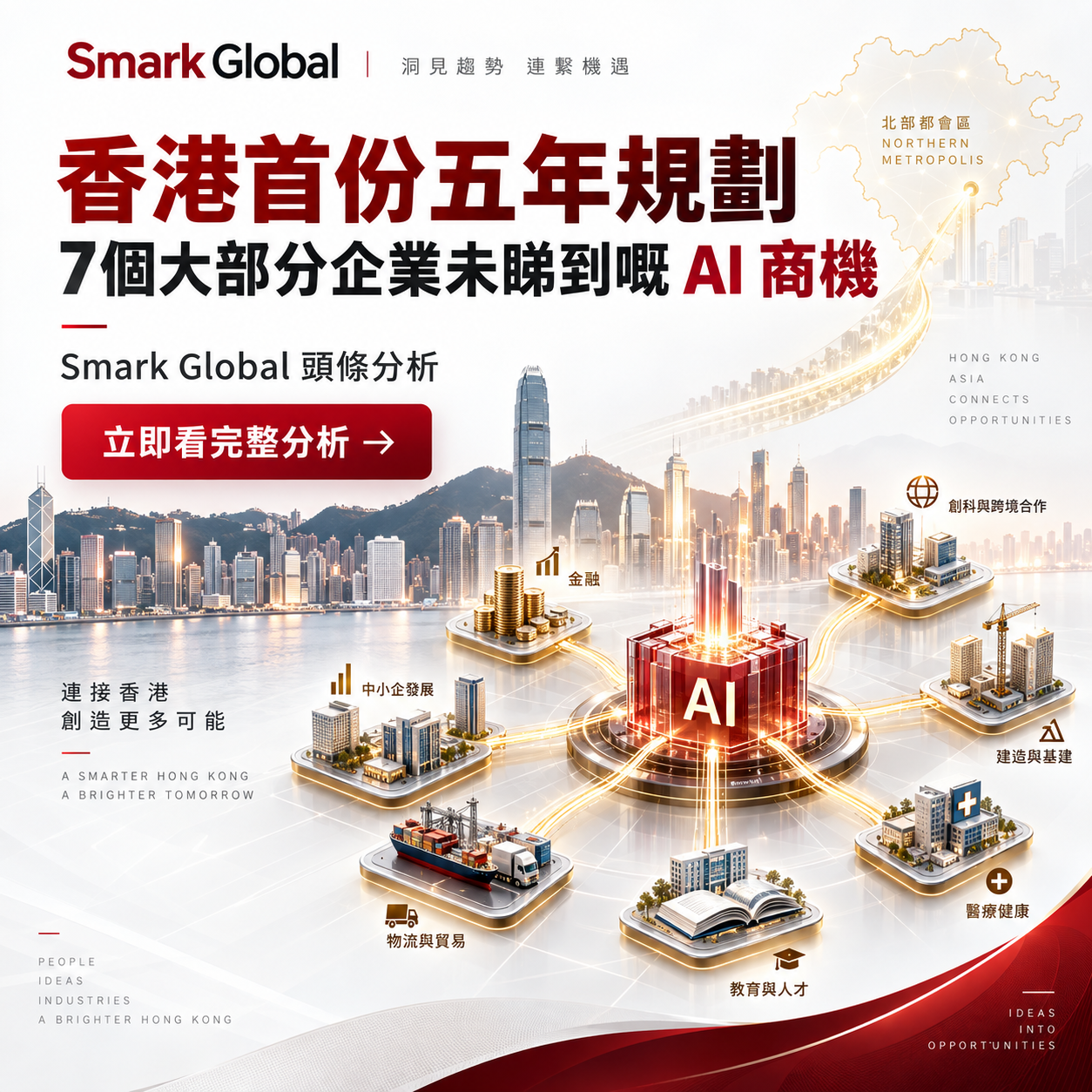
When people read Hong Kong's first Five-Year Plan and the latest Policy Address, they naturally focus on the Northern Metropolis, land, infrastructure, finance and the size of new funding programmes.
That reading may miss the most important signal for businesses.
The Government is not simply asking Hong Kong to “develop AI”. It is beginning to connect computing power, data, industry use cases, training, funding, cybersecurity, risk governance and cross-border collaboration into one industrial chain.
AI is therefore moving beyond the technology department. It will increasingly affect sales, marketing, service, management, inventory, logistics, talent and decision-making.
In my book, I make a simple distinction: saving time with AI is the first level; finding patterns with AI is the second; using AI to create new revenue is the third.
The most useful question is therefore not “Which new tool should we buy?” It is “What new problems, needs and paid services will emerge as this policy direction develops?”
Here are seven opportunities that many companies may still be underestimating.
1. AI governance will become an entry ticket to major customers
The Government plans to require bidders for selected public-facing AI services to make safety and ethical compliance declarations. It will also promote industry guidance, certification and governance frameworks, and plans to publish AI Agent safety management guidance for wider society.
Many businesses still view governance as paperwork and restriction. In practice, companies that can answer the following questions clearly will be more trusted by government buyers, regulated industries and major enterprises:
- What data does the AI use?
- Who has access?
- Which decisions require human approval?
- How can an error be traced and stopped?
- Have employees been properly trained?
This creates demand for Responsible AI programmes, AI Agent governance, supplier assessment, tender evidence and staff training. Customers will no longer ask only how powerful an AI system is. They will ask who is responsible when it goes wrong.
2. Companies need process translators more than they need more tools
The market already has no shortage of AI products. What remains scarce are people who can enter a business, understand how it really operates, redesign a process and place AI at the correct point.
A trading company does not transform its sales operation simply by buying a chatbot. It may first need to organise enquiries, quotations, margins and lost-deal reasons, then connect CRM, email, messaging, inventory and sales follow-up.
The commercially valuable work includes identifying use cases, preparing data, redesigning processes, connecting existing systems, defining human review and proving results. This is the role of an AI transformation consultant or use-case designer: translating technical capability into measurable business outcomes.
3. More free AI training will increase the value of implementation coaching
The Government plans to roll out a large number of AI courses and activities, alongside an AI skills initiative expected to benefit at least 40,000 employees.
This will commoditise basic tool training. It will not remove the need for paid enterprise learning. Instead, paid programmes will need to deliver more:
- role-specific workflows;
- practice with real company information;
- 30-, 60- and 90-day adoption follow-up;
- management decision workshops;
- AI usage and data-safety policies;
- a practical work product from every participant.
Free courses can create awareness. Paid enterprise learning must change operating results.
4. AI and cybersecurity will become a standard SME package
The Policy Address places AI and cybersecurity within the same SME transformation direction for good reason. As AI connects to contracts, customer records, finance, internal knowledge and system permissions, poor controls can magnify risk as quickly as productivity.
Businesses need practical rules covering approved tools, data classification, Agent permissions, human approval, incident response and continuing staff training. This creates a recurring market that combines transformation consulting, cybersecurity, training and periodic review.
5. Traditional industries may hold more AI gold than technology companies
The Five-Year Plan calls for traditional industries to move towards higher-value, smarter and greener operations. Long-established trading, logistics, food, retail, jewellery, watch and professional-services businesses often hold years of quotation, order, customer, inventory, complaint and operational data.
Their problem is not a lack of experience. It is that experience remains trapped in employees' memories, spreadsheets, paper and messaging apps.
These businesses do not need to build a foundation model. They can begin by identifying profitable customer types, inventory patterns, recurring service failures, effective sales behaviours and knowledge that should be transferred to new staff.
The more traditional the industry, the more unmined operational data it may possess.
6. The Northern Metropolis opportunity is the last mile between research and enterprise adoption
The Sha Ling Data Park, the Hong Kong-Shenzhen Innovation and Technology Park, San Tin Technopole, the Hong Kong AI Research and Development Institute and related funding will expand Hong Kong's capacity in computing, research and talent.
However, a research result does not automatically become a customer solution. The gap still requires enterprise use-case matching, user interviews, pilot design, workforce adoption, business-model validation, evidence creation and connections to Hong Kong, Greater Bay Area and international markets.
This last mile receives less attention than major infrastructure announcements, but it often decides whether technology generates revenue.
7. Hong Kong can become a trusted AI adoption layer for Asian businesses
Hong Kong does not need to compete head-on with the world's largest model developers. Its practical strengths include an international business system, bilingual Chinese-English capability, Cantonese use cases, professional services, finance and connections to the Greater Bay Area.
Mainland technology firms seeking international markets, and overseas AI businesses entering the Greater Bay Area, need more than translation. They need local use cases, compliance, enterprise pilots, commercial trust and cultural understanding.
Hong Kong companies going overseas will face the same requirement: they must present AI services in a form that customers can understand, audit and adopt safely.
This creates opportunities in market validation, bilingual content, enterprise training, governance and cross-border commercialisation.
The real question: is your company ready?
Policy can provide computing power, funding, courses and application scenarios. It cannot organise your customer conversations, preserve the judgement of your best employees or decide which workflow should be transformed first.
Many people believe they have adopted AI because they use it to edit emails, generate headlines or create images. These are useful activities, but they are still fragmented.
Real AI transformation connects context, data, patterns, processes and market feedback into a system that can be repeated, measured and improved.
Every management team should now ask:
- What information does our company lose every day?
- Which workflow is closest to revenue, cost or customer experience?
- If we had only 90 days, which business number would we want to change?
Do not buy tools simply because the policy environment is supportive, but do not wait until every rule is final. Start with one safe, small and measurable use case, then feed real results back into the system.
In the AI era, the greatest cost may not be the tool subscription. It may be recognising the opportunity too late.
Next steps
Complete the free AI Transformation Opportunity Scanner
Assess your organisation's current maturity across strategy, data, processes, people, systems and governance, then identify a suitable first use case.
Book an AI Transformation Readiness Scan
Smark Global can help map the current situation, identify three priority opportunities and create a 90-day implementation and measurement plan.
Read Harry Lui's book
You've Been Using AI Wrong - and It May Have Cost You Ten Million explains how business owners can move beyond asking AI isolated questions and start organising data, finding patterns, building systems and amplifying business capability.
- Website: www.smarkglobal.com.hk
- Email: info@smarkglobal.com
- Phone: +852 2741 4322
- Book: Amazon
Official sources
- Hong Kong's First Five-Year Plan (2026–2030)
- 2026 Policy Address, Chapter 3
- 2026 Policy Address, Chapter 5
This is Smark Global's independent business analysis and does not represent the views of the Government. Funding eligibility, application details and policy timelines remain subject to the latest official announcements.